| www.tmatlantic.com
Test & Soldering Equipment On-line Store |
|
D.E.V.I.C.E. (Wiki)Calculators Services |
|||||



Filter by first letter
|
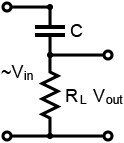
Transformerless Power Supply CalculatorDesigning low-current electronics for smart home sensors, LED drivers, or microcontroller nodes requires a compact, budget-friendly power management strategy. This interactive calculator allows you to quickly compute the capacitor value required for transformerless power supply circuit. A simple transformerless power supply with resistive load can be used if there is a need to connect to the AC mains a load designed for a voltage (Vout) much less than the mains voltage (Vin), for example, a soldering iron. In this circuit a capacitor (C) and resistive load (RL) are connected in series to AC mains to limit incoming current cleanly.
To calculate the capacitor value this tool uses the following equation: C = (Pout / Vout) / (2πf√(Vin² - Vout²)) Frequently Asked QuestionsWhy does the output voltage of a transformerless supply drop when the load current increases? This circuit configuration behaves as a constant current source rather than a constant voltage source. The maximum current is strictly governed by the fixed impedance of the X2 capacitor. If your load attempts to draw more current than the capacitor's reactance allows, the voltage across the load will collapse toward zero because there is no reserve energy storage reservoir, unlike in traditional magnetic transformer systems.
Can a transformerless power supply be used for circuits requiring more than 200 mA? Practically, no. Sourcing 200 mA from a 120 V / 60 Hz line requires an exceptionally large X2 capacitor value (approximately 4.4 µF). A safety capacitor of this value is physically bulky, expensive, and creates significant reactive power distortion on the AC line, defeating the primary advantages of size and cost savings.
How do you calculate the current output of a capacitive transformerless power supply? The maximum output current (Iout) depends primarily on the capacitive reactance (XC) of the AC-line dropping capacitor. To find the available current, divide your standard AC mains voltage (Vin) by the reactance value: Iout ≈ Vin / XC, where XC = 1 / (2πfC).
What type of capacitor is required for a transformerless AC to DC drop circuit? You must strictly use a specialized metallized film safety capacitor rated Class X2. These components are specifically engineered to connect directly across raw AC power lines (120 V or 230 V). A standard ceramic or electrolytic capacitor will quickly overheat, experience dielectric breakdown, fail closed, and cause a dangerous catastrophic electrical fire.
How does a capacitive transformerless power supply drop AC mains voltage safely? A capacitive power supply utilizes the capacitive reactance of a series capacitor to act as an AC current-limiting element. Instead of dropping voltage by generating massive thermal heat losses (like a resistive voltage divider), the capacitor drops voltage cleanly across a downstream Zener shunt regulator by introducing a 90° electrical phase shift between voltage and current.
What is the mandatory purpose of the bleeder resistor in a capacitive drop layout? A high-value resistor (typically 470 kΩ to 1 MΩ) must be soldered in parallel directly across the dropping capacitor. When the electrical device is unplugged from the wall socket, the capacitor can store a hazardous, high-voltage DC charge for days. The bleeder resistor provides a slow, safe discharge path that drains this residual voltage down to zero within seconds, preventing severe electrical shock during maintenance.
What are the main limitations and safety risks of transformerless power supplies? The primary limitation is a complete lack of galvanic isolation. The low-voltage DC ground plane is directly tied to either the live or neutral AC power wire. If a user touches any uninsulated metal part of the device, they risk lethal electrocution. Additionally, these circuits are strictly limited to low-current devices (typically under 100 mA), as scaling up the current requires an impractically large and expensive X2 capacitor.
|
Units Converter
|








|