| www.tmatlantic.com
Test & Soldering Equipment On-line Store |
|
D.E.V.I.C.E. (Wiki)Calculators Services |
|||||



Filter by first letter
|
Wire Resistance CalculatorEvery foot of electrical wire acts as a tiny parasitic resistor, stealing voltage and converting it into wasted heat. This online Wire resistance calculator evaluates the electrical resistance of a specific wire. The resistance of a wire depends on its material and geometrical dimensions (length and diameter or cross-sectional area). Minimizing internal cable resistance is mandatory when planning long-distance solar panel arrays, industrial motor feeds, high-fidelity speaker cabling, or precision DC sensor loops.
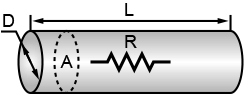
This tool uses the following resistance formula: R = ρ × L / A where:
R – Resistance in Ω; If you know the diameter (D) of the wire its cross-sectional area (A) will be calculated as: A = π / 4 × D² This calculator allows to use American Wire Gauge to determine cross-sectional area of the wire. Frequently Asked QuestionsWhy does wire resistance increase as the temperature goes up? In metal conductors, heat causes the atomic lattice to vibrate aggressively. These rapid thermal vibrations create a chaotic path for moving electrons, causing them to collide with atoms more frequently. These constant atomic collisions physically restrict electron velocity, causing a measurable spike in total electrical resistance.
What is the difference between solid and stranded wire resistance? For standard DC and low-frequency AC power lines, a solid wire and a stranded wire of the exact same AWG gauge share identical resistance profiles. However, stranded wire has a slightly larger overall outer diameter to account for the air gaps between individual strands, making it highly flexible and resistant to structural stress fractures.
How does wire resistance affect high-frequency AC signals? At high frequencies (such as radio transmissions or high-speed data arrays), a phenomenon known as the Skin Effect occurs. Alternating current pushes away from the core and travels strictly along the outer layer or "skin" of the conductor. This artificially restricts the usable cross-sectional area, causing the high-frequency AC resistance to be significantly higher than the standard DC resistance calculated by this tool.
|
Measurement History Events
Units Converter
|









|