| www.tmatlantic.com
Test & Soldering Equipment On-line Store |
|
D.E.V.I.C.E. (Wiki)Calculators Services |
|||||



Filter by first letter
|
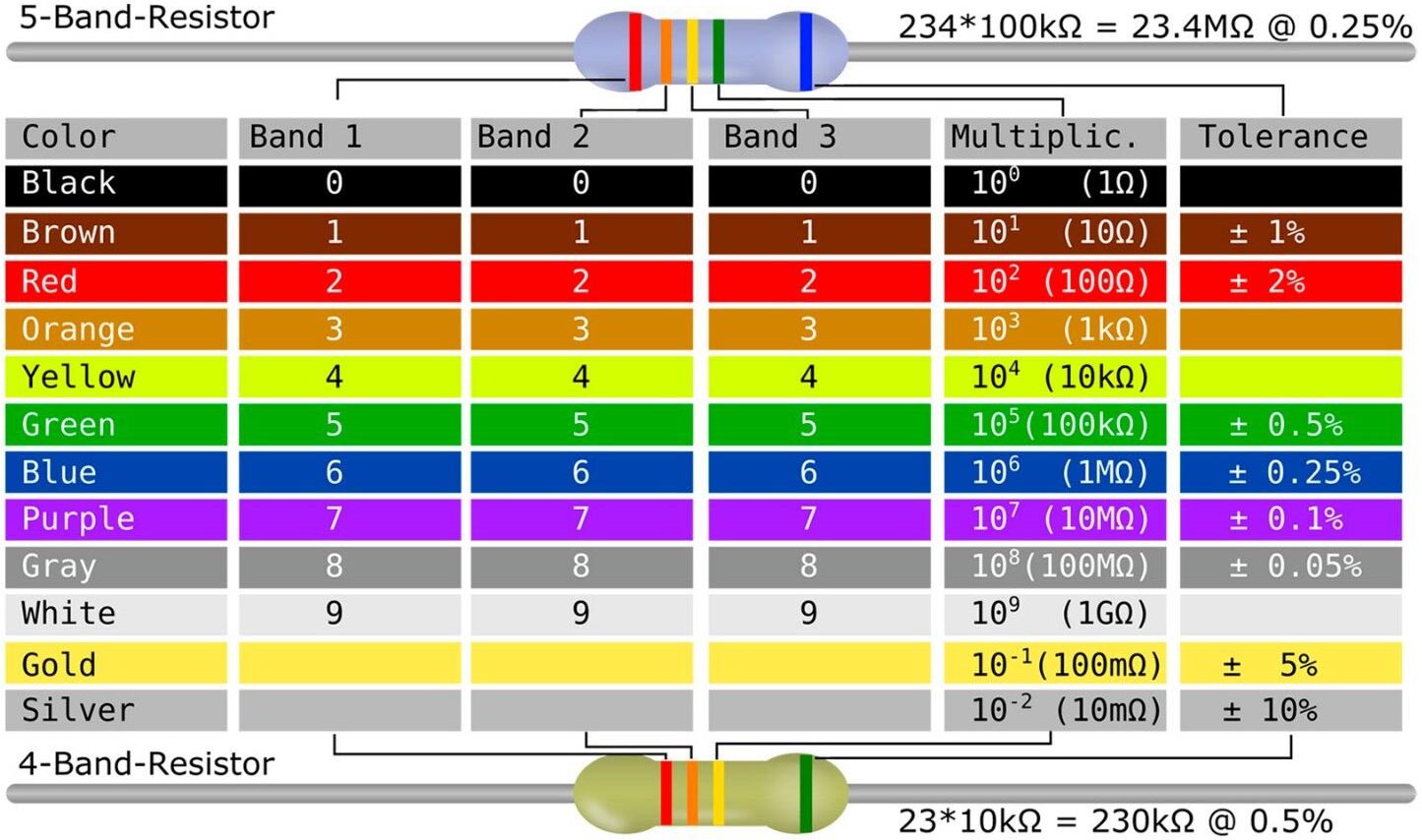
Resistor Color Code CalculatorDetermining the resistance value, multiplier, and tolerance of through-hole resistors doesn't require manual chart-checking or guesswork. This interactive resistor color code calculator allows you to determine resistance by resistor color coding and to determine resistor color coding by resistance. It displays Rated resistance, Resistor tolerance, Resistor length and Resistor power all in one easy to read chart. Whether you are troubleshooting a vintage PCB, assembling an Arduino prototype, or verifying components for a hardware manufacturing run, accurate resistance matching prevents circuit failures and component burnout. How to Read Resistor Color BandsAxial resistors use a standardized color coding system established by the EIA (Electronic Industries Alliance). To use the calculator or read a resistor manually, position the component so the tolerance band (typically a wider gap or a gold/silver band) is on the right side. You read the bands from left to right.
Why Precision Matters in Circuit DesignWhile standard consumer electronics often rely on 5% or 10% tolerance resistors, high-frequency RF equipment, medical devices, and aerospace telemetry require 1% or finer precision. A minor thermal drift can destabilize operational amplifiers or shift filter cutoff frequencies. Use this calculator to verify that your selected component matches the tolerance requirements of your schematic. Resistor Color Code and SMD Resistor Code CalculatorFrequently Asked QuestionsHow do I read a 4-band resistor color code? To read a 4-band resistor color code, hold the resistor with the wider gap between bands on the right. The first two bands from the left represent the significant digits. The third band is the multiplier (the power of 10 by which you multiply the digits), and the fourth band indicates the tolerance percentage. For example, a resistor with Yellow, Violet, Red, and Gold bands translates to 4, 7, ×100, and ±5%, resulting in a 4.7 kΩ resistor with a 5% tolerance.
What is the 10kΩ resistor color code for 4-band and 5-band components? The 4-band color code for a standard 10 kOhm resistor is Brown, Black, Orange, and Gold (assuming a standard 5% tolerance). For a precision 5-band 10 kOhm resistor with 1% tolerance, the sequence is Brown, Black, Black, Red, and Brown. The extra black band provides the third significant digit (0), while the red band acts as the ×100 multiplier.
Which way do you read resistor color codes when both ends look identical? Look for a slight structural or spacing clue: the tolerance band is typically separated from the other bands by a wider gap. If the spacing is perfectly symmetrical, look at the colors. Standard tolerance bands are usually Gold (5%) or Silver (10%). Since resistors rarely start with gold or silver, the end opposite to the gold/silver band is your starting point (left side). For high-precision resistors, the first band is often thicker or closer to the lead edge.
Why does my resistor color code calculator result not match standard resistor values? Resistors are manufactured in specific preferred value series, most commonly the E-series (like E12, E24, or E96). If your custom calculations or color-band inputs yield an unusual number (e.g., 4.35 kΩ), you likely misidentified a color band under poor lighting (such as confusing red with orange, or brown with red) or the component is a specialized, non-standard precision resistor. Always verify critical values using a digital multimeter (DMM).
|
Units Converter
|








|