| www.tmatlantic.com
Test & Soldering Equipment On-line Store |
|
D.E.V.I.C.E. (Wiki)Calculators Services |
|||||



Filter by first letter
|
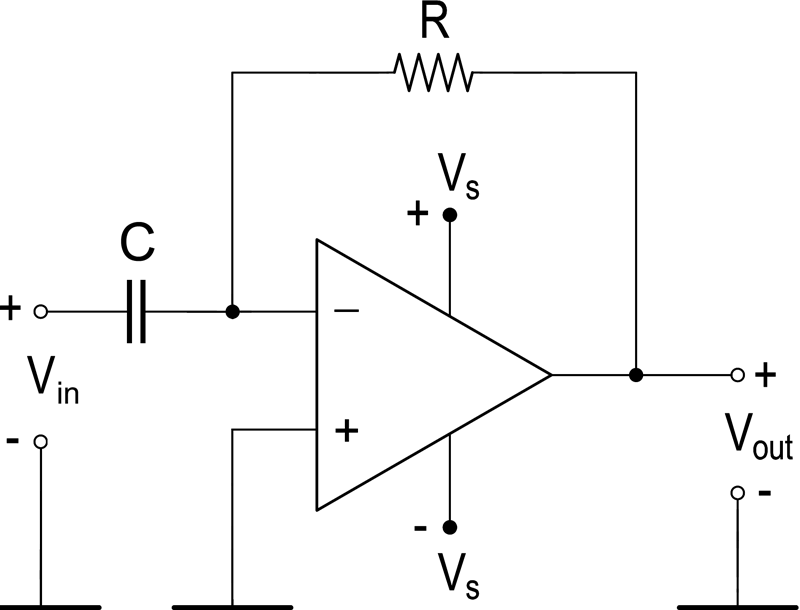
DifferentiatorA differentiator based on an operational amplifier is most often built on the basis of an inverting amplifier and is shown in Fig. 1.
Such a connection circuit differentiates in time and inverts Vin and gives the output Vout, determined by the formula: Vout = –R × C × (dVin / dt)
The circuit can be considered as a high-pass filter (HPF), which, together with a low-pass filter, is used in various automation devices and analog signal processing. Frequently Asked QuestionsWhat is the difference between an op amp differentiator and an op amp integrator? The two circuits perform inverse mathematical operations by swapping the physical positions of the resistor and capacitor. An integrator uses an input resistor and a feedback capacitor to calculate the cumulative area under the signal curve over time, which smooths out sharp transitions (e.g., turning square waves into triangle waves). A differentiator uses an input capacitor and a feedback resistor to calculate the instantaneous rate of change of the signal, which sharpens edges and detects transitions (e.g., turning square waves into sharp spikes).
|
Measurement History Events
Units Converter
|








|