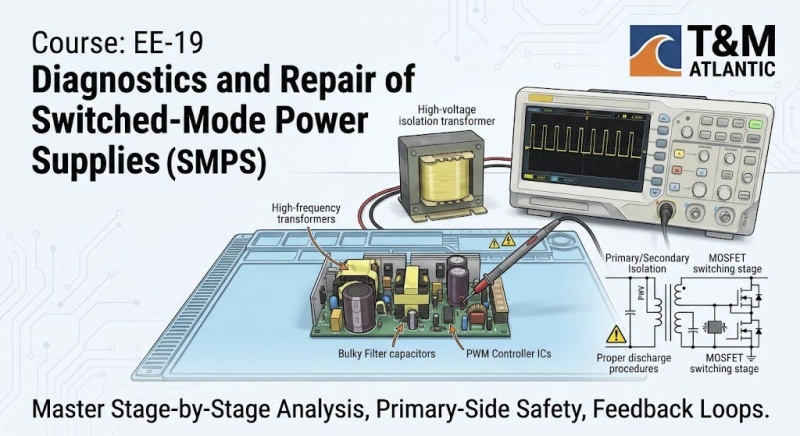
Every electronic device relies on an efficient power supply. When failures occur, the primary/secondary power stages are usually the culprit. This course bridges the gap between basic electrical measurements and component-level power electronics repair.
Objective and Audience
This course teaches engineers, repair technicians, and electronics enthusiasts how to systematically analyze, diagnose, and repair Switched-Mode Power Supplies (SMPS) found in consumer electronics, industrial automation, and LED lighting units.
The course is intended for individuals who can safely use a digital multimeter and an oscilloscope. Courses EE-6 Basics of measuring with a multimeter, EE-8 Troubleshooting Electronic Circuits With an Oscilloscope, and EE-1 Basics of Diagnostics and Repair serve as ideal prerequisites.
Proposed Format
Ten 90-minute lessons, totaling 15 instructional hours. Combines circuit theory, safety protocols (isolation transformers), and live bench diagnostics of faulty power supplies.
Learning Outcomes
By the end of the course, participants will be able to:
- Explain the topology and stage-by-stage operation of flyback, forward, and buck converters.
- Safely handle high-voltage primary circuits using isolation transformers and proper discharge procedures.
- Test individual components under power or in-circuit: MOSFETs, Schottky diodes, optocouplers, electrolytic capacitors, and PWM controllers.
- Trace and resolve common SMPS faults: no output, voltage sagging, hiccup mode, excessive ripple, and catastrophic primary-side short circuits.
Lesson Plan
- SMPS Fundamentals and Safety:
Linear vs. switched power supplies, primary/secondary isolation, and safe bench practices.
- EMI Filtering and Rectification:
AC input stage, fuses, varistors, bridge rectifiers, and bulk filter capacitors.
- Power Switching Stage:
Working principles of power MOSFETs and IGBTs in high-frequency switching circuits.
- Transformer Operation & Flyback Topology:
Energy storage, magnetic coupling, and snubber circuit design.
- Secondary Rectification & Filtering:
Fast recovery diodes, synchronous rectification, and low-ESR capacitor filtering.
- Feedback and Regulation Loops:
Optocouplers (PC817), TL431 shunt regulators, and voltage feedback stabilization.
- PWM Controller ICs:
Startup circuits, internal oscillators, current sensing, and protection features (OCP, OVP).
- Diagnostic Methodology & Tooling:
Using DMMs, ESR meters, and oscilloscopes safely on live high-voltage boards.
- Common Failure Case Studies:
Step-by-step repair of dead supplies, pulsing outputs, and blown switching transistors.
- Final Practical Troubleshooting:
Diagnosing an instructor-faulted SMPS board, documenting measurements, and executing a safe repair.
Back to the section
|