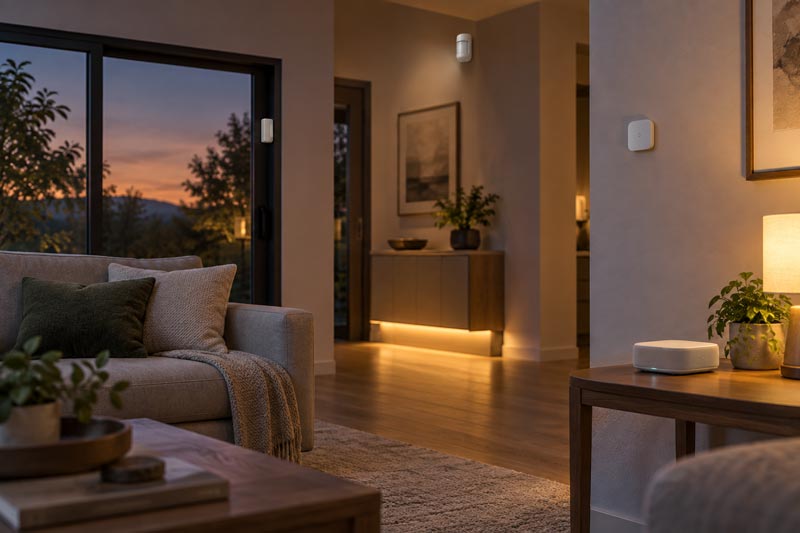
This practical course teaches participants how to create reliable sensor-based smart home automation scenarios. Students learn to configure motion, light, temperature, door, and leak sensors; create if-then rules; add time and occupancy conditions; test notifications; prevent conflicting commands; and provide manual control when a sensor, network, or controller fails. The course consists of eight 90-minute lessons and concludes with two tested automation scenarios.
Goal
Create reliable scenarios with clear triggers, verified outcomes, and manual control.
Audience
Users with a working basic system and specialists in low-voltage home automation.
Proposed format
Eight 90-minute lessons, 12 instructional hours.
Lesson topics and hands-on tasks
- State a household task, desired action, and measurable success criterion.
- Check readings from motion, light, temperature, or door sensors; account for delay and false triggering.
- Create an if-then rule for a low-voltage LED training fixture; verify on/off actions and manual override.
- Add time, light-level, and occupancy conditions; prevent repeated or conflicting commands.
- Set up a notification from a training leak or door sensor; test delivery and behavior when connectivity fails.
- Review a smart plug's or meter's readings if the model supports them; compare two operating states without promising savings.
- Specify behavior when a sensor, network, or controller fails; include a way to disable the rule and use manual controls.
- Final project: two scenarios, condition diagrams, test logs, limitations, and user instructions.
Equipment
Scenario-capable controller and app, low-voltage LED training module, compatible sensors, and if needed a ready-made certified smart plug. Electrical installation, building wiring changes, gas appliance control, and promises of fire or flood protection are outside the exercises.
Outcome
Two repeatable scenarios with documented tests. Energy savings can be assessed only from measurements of a specific installation.
Sources and technical references
- T&M Atlantic EE-5 Basics of building smart home systems and remote control of household appliances
- Connectivity Standards Alliance Matter FAQ
- Connectivity Standards Alliance Why Bridging Matters
- NIST Seven Tips to Keep Your Smart Home Safer and More Private
Back to the section
|