|
Course: EE-18 Short-Range Wireless Protocols in Smart Home (Zigbee, Z-Wave, Thread, BLE)
Course: EE-18 Short-Range Wireless Protocols in Smart Home (Zigbee, Z-Wave, Thread, BLE)
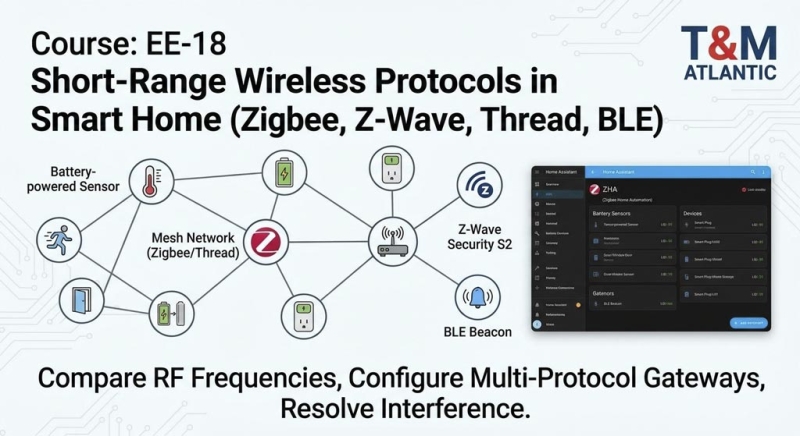
Click an image to enlarge
|
|
|
While Wi-Fi is ideal for high-bandwidth video and heavy data streams, robust smart home automation relies heavily on local mesh networks. This course equips engineers, installers, and advanced DIYers with the expertise to deploy reliable Zigbee, Z-Wave, Thread, and BLE networks without cloud dependency.
Objective and Audience
This course provides a comprehensive study of local mesh and short-range wireless protocols used in modern smart home ecosystems. Participants will learn how to architect, configure, and troubleshoot non-Wi-Fi networks, connect battery-powered wireless sensors, and manage local multi-protocol gateways.
The course is intended for automation technicians, smart home installers, and IoT developers who already understand basic microcontroller systems and network concepts. Completion of EE-31 Embedded Systems for Smart Home or EE-5 Basics of building smart home systems provides ideal preparation.
Proposed Format
Ten 90-minute lessons, totaling 15 instructional hours. Each session combines theoretical architecture reviews with practical gateway setup, node pairing, and network sniffing exercises.
Learning Outcomes
By the end of the course, participants will be able to:
- Compare radio frequencies, power consumption profiles, and topologies of Zigbee, Z-Wave, Thread, and Bluetooth Low Energy (BLE).
- Set up and configure multi-protocol USB coordinators and local automation hubs (e.g., Home Assistant ZHA / Zigbee2MQTT).
- Pair, bind, and configure battery-operated wireless end-devices and routers.
- Analyze radio interference, channel congestion, and mesh routing issues using diagnostic sniffers.
Lesson Plan
- Introduction to Short-Range RF:
Comparison of 2.4 GHz and Sub-GHz bands, mesh vs. star topologies, and protocol trade-offs.
- Bluetooth Low Energy (BLE) Fundamentals:
Advertising, scanning, GATT characteristics, and connecting beacons/sensors.
- Zigbee Architecture & Coordinator Setup:
Zigbee Pro stack, binding, commissioning, and USB dongle configuration.
- Zigbee End-Devices and Routing:
Routers vs. end-devices, sleepy nodes, network healing, and device pairing.
- Z-Wave Technology & Security:
800/900 MHz advantages, S2 security, inclusion/exclusion, and route optimization.
- Thread Protocol & Matter Integration:
IPv6-based mesh networks, border routers, and synergy with the Matter standard.
- Local Hub Integration:
Connecting Zigbee/Z-Wave/BLE adapters to Home Assistant and managing entity states.
- Multi-Protocol Coexistence:
Mitigating 2.4 GHz interference between Wi-Fi and Zigbee/BLE channels.
- Diagnostics and Sniffing:
Using packet analyzers and link quality indicators (LQI) to resolve mesh bottlenecks.
- Final Integration Project:
Designing a robust multi-protocol smart home network topology and troubleshooting simulated dropouts.
Back to the section
|
|
|






